Ready Reckoner Rate 2026: Ultimate Guide for Buyers & Investors
Buying a home or investing in property is one of the biggest financial decisions you will ever make. And right at the heart of that decision lies a number many first-timers overlook: the Ready Reckoner Rate. This one government-notified figure can quietly add lakhs to your total purchase cost.
Whether you are a first-time homebuyer in Mumbai, an NRI investor eyeing Pune's booming IT corridors, or a family looking to settle in Navi Mumbai, understanding the Ready Reckoner Rate is no longer optional—it is the foundation of a smart property decision.
At RealEstate Talk, India's first social networking platform built exclusively for the property industry, we believe that knowledge shared within a trusted community is the key to making confident real estate choices. Think of us as LinkedIn for the property world—a space where buyers, sellers, agents, architects, mortgage advisors, and even Vaastu consultants come together to connect, learn, and grow.
Ready to decode the Ready Reckoner Rate together? Let's dive in.
What is the Ready Reckoner Rate (RRR)? A Simple Guide for Homebuyers
When you buy a property, two prices are always in play—the price you agree upon with the seller, and the minimum price the government has set for that locality. That government-set price is the Ready Reckoner Rate, or RRR for short. In simple words, it is the least value at which a property can be legally registered in India.
Depending on which state you are in, you may hear this called by different names. In Maharashtra, it is the Ready Reckoner Rate. In Delhi, UP, and Haryana, people call it the Circle Rate. Head down south to Karnataka or Tamil Nadu, and it is the Guidance Value. In Gujarat, it goes by Jantri. Whatever the local name, the purpose remains the same: to stop property undervaluation, curb black money, and ensure the government collects the right stamp duty and registration charges.
Why do governments set this rate?
The government reviews and updates these rates—usually at the start of every financial year—based on factors like location, property type, market demand, nearby infrastructure, and overall economic conditions. Think of it as the government's way of saying, "This is the least a property in this area should be worth."
Why Does the Ready Reckoner Rate Matter for Your Property Purchase?
You might wonder, "It's just a government rate, why should I lose sleep over it?" The answer lies in how deeply this one number affects nearly every rupee you spend on a property transaction. It directly determines your stamp duty, influences your home loan eligibility, and even decides how much tax a seller pays.
At RealEstate Talk, our community members frequently discuss how understanding the RRR early helped them negotiate better and avoid last-minute financial shocks. Whether you prefer to deal directly with owners or work through a trusted estate agent—our platform supports both paths, respecting the choices of every buyer and seller.
Direct Impact on Stamp Duty and Registration Costs
This is the most immediate and visible impact. The rule is simple: your stamp duty and registration charges are calculated on the higher of the two values—the Ready Reckoner Rate or your actual transaction value.
Let that sink in. Even if you negotiate a fantastic deal with the seller, if the government's RRR is higher, your stamp duty will be paid on that higher amount. For a buyer in Maharashtra, where stamp duty can range from 5% to 7% of the property value, even a small difference between the transaction price and the RRR can mean tens of thousands of rupees in extra costs.

How RRR Affects Your Home Loan Eligibility
When you approach a bank for a home loan, they don't just look at your salary slip. They assess the property's market value to decide the Loan-to-Value (LTV) ratio—essentially, how much they are willing to lend you as a percentage of the property's worth. While banks primarily rely on market value, the RRR acts as a floor. If the transaction value is significantly lower than the RRR, the bank may peg your loan eligibility to the lower transaction value, reducing the maximum loan amount you can get and increasing your required down payment.
RRR and Capital Gains Tax: What Sellers Need to Know
If you are on the selling side, pay close attention. Under Section 50C of the Income Tax Act, if you sell a property for a price that is lower than the Ready Reckoner Rate, the Income Tax Department will treat the RRR-based stamp duty value as your "sale price" for the purpose of calculating capital gains tax.
This means you could end up paying tax on an income you never actually earned. The only relief? A 10% tolerance band—if the difference between your sale price and the RRR is within 10%, the actual sale consideration is accepted. Beyond that, you may face a hefty tax bill.
Ready Reckoner Rate vs. Circle Rate vs. Market Value: Knowing the Difference
Before you move forward, it helps to clear up a common confusion. What exactly is the difference between the Ready Reckoner Rate, the Circle Rate, and the actual Market Value? Let's break it down so you never mix them up again.
Three terms, one core idea
As we discussed, RRR and Circle Rate are functionally the same thing—just called by different names across different states. The real distinction is between the government-notified rate (RRR/Circle Rate) and the Market Value.
Parameter | Ready Reckoner Rate (or Circle Rate) | Market Value |
|---|---|---|
Who sets it? | State Government | Buyer and Seller through negotiation |
Based on what? | Location, infrastructure, property type | Demand-supply, amenities, builder reputation |
How often does it change? | Revised annually (usually in April) | Fluctuates constantly with market conditions |
Can a transaction happen below it? | No—it is the legal floor for registration | Yes—but stamp duty is paid on the higher RRR value |
Used for? | Stamp duty, registration, capital gains tax | The actual money that changes hands |
How to Calculate Ready Reckoner Rate for Your Property in 2025
Now for the practical part. How do you actually calculate the RRR-based value of a property you are considering? The math is surprisingly straightforward, and once you learn it, you can run the numbers for any property in minutes. Many savvy buyers on RealEstate Talk use this quick calculation to compare deals across different localities before even visiting a property.
Step-by-Step Guide to Calculate Property Value Using RRR
Here is the formula that can save you lakhs:
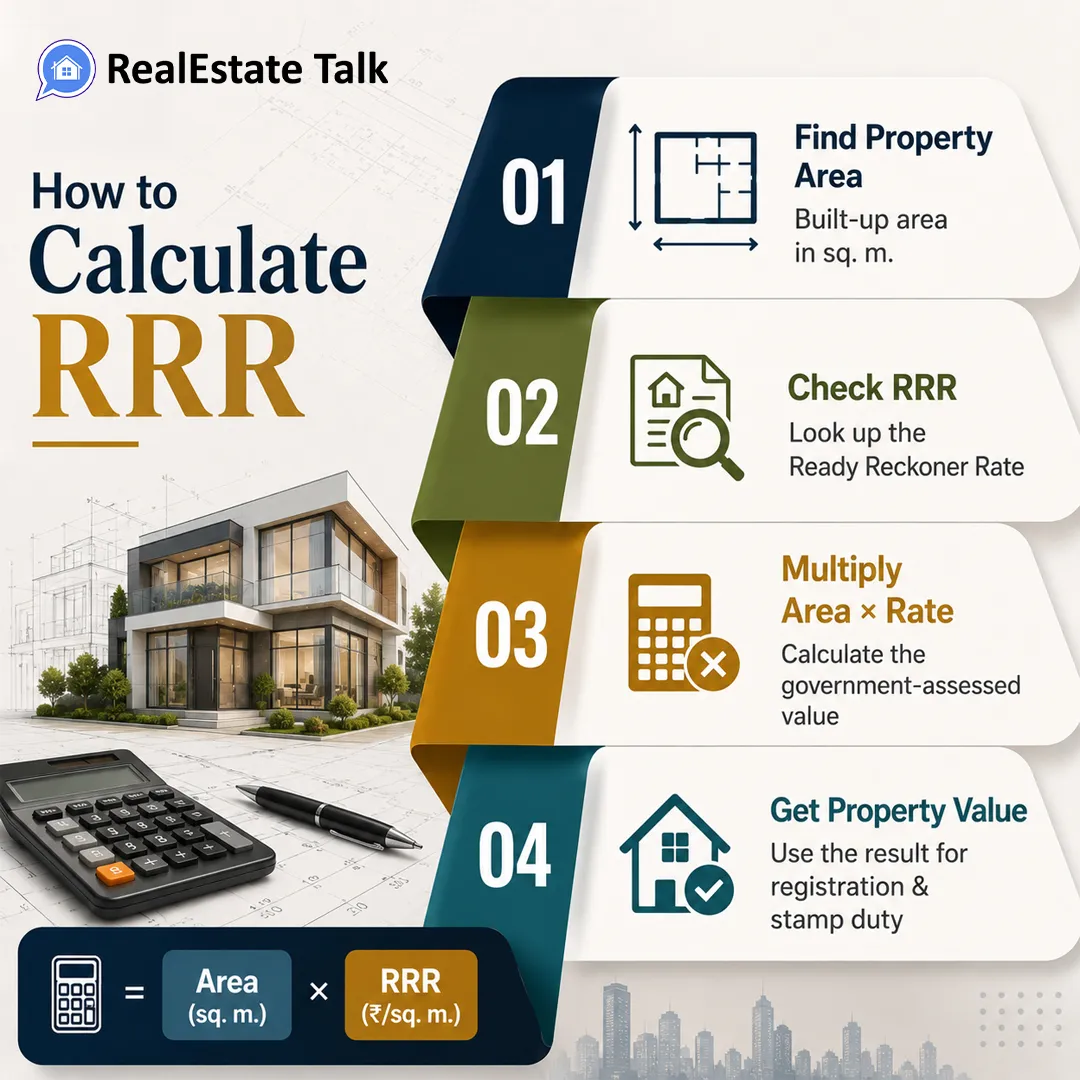
Property Value (as per RRR) = Built-up Area (in square meters) × Ready Reckoner Rate (per sq. m.)
Follow these four simple steps:
- Find the exact built-up area of your property in square meters. If you have it in square feet, divide by 10.764.
- Visit your state's land records portal (more on this below) and look up the RRR for your specific taluka and village.
- Note the per-square-meter rate for your property type (residential, commercial, or industrial).
- Multiply the area by the rate. That is your minimum government-assessed property value.
- Add the car parking area if applicable—parking spaces have their own separate rate.
Bonus tip: Women buyers in Maharashtra get a 1% concession on stamp duty for residential properties, which can translate to significant savings.
Practical Examples: Calculating RRR for a Flat in Pune and Mumbai
Let's make it real with two examples:
Example 1 – A flat in Pune: Suppose you are buying a residential flat in a Pune Municipal Corporation (PMC) area. The built-up area is 80 square meters, and the RRR for that locality is ₹60,350 per sq. m. Your property's government value = 80 × ₹60,350 = ₹48,28,000 (approx. ₹48.28 lakh).
Example 2 – A flat in Mumbai Suburban: Now consider a flat in Mumbai Suburban with a built-up area of 65 sq. m. and an RRR of ₹1,20,000 per sq. m. Government value = 65 × ₹1,20,000 = ₹78,00,000 (₹78 lakh). Your stamp duty and registration will be calculated on this amount if your negotiated price is lower.
How to Check the Latest Ready Reckoner Rates Online (State-wise Guide)
Gone are the days of visiting dusty government offices. Today, checking the Ready Reckoner Rate for any locality is a digital-first process. Whether you are buying a home or evaluating an investment, here is how you can access the rates for free from your phone or laptop.
Maharashtra: Your Complete Guide to the IGR Portal & e-ASR
For Maharashtra, the Inspector General of Registration (IGR) maintains a user-friendly portal at igrmaharashtra.gov.in. Here is exactly what to do:
- Visit the IGR Maharashtra website.
- Look for the "e-ASR" (Annual Statement of Rates) section.
- Select your District from the dropdown.
- Choose your Taluka.
- Select the Village or locality.
- The portal will display the per-square-meter rate for residential, commercial, and other property types.
The e-ASR system is updated every April to reflect the new financial year rates. Always double-check you are viewing the latest version for 2025-26.
Other States: Finding Circle Rates/Guidance Values Across India
Each state has its own digital portal:
- Karnataka: Use the Kaveri Online Services portal to check Guidance Values for Bangalore and other cities.
- Delhi: The e-Circle Rate is available on the Delhi government's revenue department website.
- Uttar Pradesh & Haryana: Check the respective state land records portals for circle rates, often listed under the district collector's section.
- Gujarat: Look for the Jantri rates on the state revenue department's website.
No matter which state you are buying in, RealEstate Talk connects you with local agents and legal experts who can help you navigate the state-specific details. It's like having a property-savvy friend in every city.
Ready Reckoner Rates 2025-26: Key City-Wise Analysis for Investors
For the financial year 2025-26, the Maharashtra government announced an average hike of 3.89% in Ready Reckoner Rates across the state. This was the first revision in two years, impacting everything from stamp duty costs to property valuations.
But the headline number doesn't tell the full story. The hike varied dramatically from city to city, creating distinct investment implications depending on where you are looking. Let's break down the major cities so you can plan better.
Want real-time insights from local investors in these cities? On RealEstate Talk, our Reverse Discovery Engine lets property owners and agents proactively find and pitch to verified, high-intent buyers—meaning investors can get matched with exactly the right opportunities without spam or unwanted calls.

Key RRR Hikes Across Maharashtra Cities (2025-26):
City / Area | RRR Hike (%) | What It Means for You |
|---|---|---|
Mumbai (MCGM area) | 3.39% | Moderate hike; stable high-value market |
Solapur | 10.17% | Highest hike; driven by new infrastructure |
Ulhasnagar | 9.00% | Sharp rise; watch for future growth |
Thane | 7.72% | High-growth corridor; strong residential demand |
Nashik | 7.31% | Emerging industrial and residential hub |
Navi Mumbai | 6.75% | Infrastructure-led appreciation |
Pimpri-Chinchwad (PCMC) | 6.69% | Rapid IT-led residential expansion |
Panvel | 4.97% | Steady growth with connectivity upside |
Pune (PMC) | 4.16% | Balanced increase; sustained IT demand |
Nagpur | 4.23% | Consistent growth; logistics hub potential |
Mumbai Suburban & City: Analyzing the 3.39% Hike
Mumbai saw one of the lowest hikes in the state at just 3.39%. Why? Limited land availability, a mature real estate market, and high base rates mean the room for sharp annual increases is naturally capped. For luxury and premium segment buyers, this modest hike is a relief—the absolute impact remains manageable. However, for the mid-segment buyer (₹1-2 crore range), even a 3.39% hike on high base values can add ₹2-4 lakh to the total acquisition cost.
Pune & Pimpri-Chinchwad: A Deep Dive into the 4-7% Hike
Pune and its sister city Pimpri-Chinchwad tell a tale of two growth stories. While Pune Municipal Corporation areas saw a 4.16% hike, PCMC recorded a significantly higher 6.69% increase. This divergence reflects PCMC's rapid transformation into a major IT and industrial corridor, with new metro connectivity and infrastructure projects driving property demand. For long-term investors, the higher RRR hike in PCMC signals strong government confidence in that corridor's appreciation potential.
Navi Mumbai, Thane & Nashik: High-Growth Corridors
These three cities are the ones to watch closely. Thane led with a 7.72% hike, followed by Nashik at 7.31% and Navi Mumbai at 6.75%. Each of these corridors benefits from massive infrastructure projects—the Navi Mumbai International Airport, multiple metro lines, and industrial expansion in Nashik. A higher RRR hike typically means the government expects these areas to grow rapidly. For investors, it signals both opportunity and a warning: the cost of entry is rising, so delaying your decision could mean a more expensive purchase next year.

Comments
Post a Comment